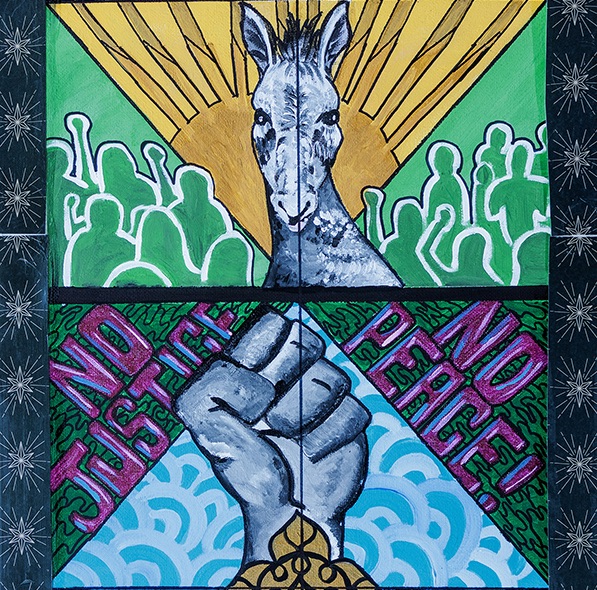
On Palm Sunday, we entered Holy Week by gathering for breakfast in each other’s homes. Each brunch group put on a skit to join the crowds that gathered to welcome Jesus as he entered Jerusalem. (If you were not able to attend, Mark 11:1–11 recollects this day.) The day before, March 28th, 8 million people gathered around the world in the No King’s protest against the rise of right-wing politics, fueled in part by Christian nationalism in the US. It was the largest protest in the history of the US. The Spirit of Jesus riding into the center of power on a donkey is very much alive. We ground ourselves in good news. We watch for what is emerging in this moment as we follow Jesus, the Christ.
“Jesus of Nazareth, you spent your days teaching and healing. You befriended people in the streets and walked on water. You laid hands on the sick and broke bread at crowded dinner tables. Your good news was not confined to the Temple. Your good news was a subversive act of love, grounded in the world.” — S.A.
On Maundy Thursday, Jesus had a Passover meal with the disciples, his closest friends. Knowing he would soon be betrayed by Judas and that his death was imminent, Jesus cared for his disciples, including Judas, by feeding them bread and wine and washing their feet. We remember this mercy and the radical flavor of Jesus’ love. If you would like to remember this moment in the life of Jesus, read John 13:1–35.
“All confrontational nonviolence done in Jesus’ name invites the oppressor to be human again, not through dehumanizing power, but through the humility of our interdependence on each other. It is both unsurprising and devastating that, after his feet have been washed, Judas still runs to betray his Lord.” — S.A.
On Good Friday, Jesus was stripped, whipped, carried a heavy crossbeam to his place of death, and was crucified. He chose not to use his power to protect himself. Instead, he forgave the soldiers and crowds who crucified him, welcomed a thief into paradise, and entrusted his mother into John’s care. Jesus’ love was revealed through nonviolence. If you would like to reflect on this moment, drop by Kingfisher Farm between 1–3, or spend time reading Luke 22:47–53; Luke 23:33–38, 44–46.
“Where is the good news on Good Friday? Where do we see glimpses of goodness within an awful, brutal story? Jesus kisses the one who betrays him. He exclaims, “no more!” in the fury of drawn swords, offering healing instead. He uses his final breaths to plead for forgiveness for those who have crucified him. Jesus is stripped of all decency and humanity, yet his actions reveal the good news of a peaceful God. Meanwhile, the actions of others around him—the betrayals, the mocking, the derision, the mob mentality, and the violence—reveal who we are at our worst.” — S.A.
Blessings,
Anne